Short answer. The Jerónimos Monastery in Lisbon grew out of a small hermitage for sailors at Belém. King Manuel I gave the site to monks of the Order of Saint Jerome, building began in 1501 or 1502, and the work went on for about a century under four successive masters. The monks stayed until the religious orders were abolished in 1833 and 1834, then the Casa Pia occupied the building until 1940. UNESCO listed it in 1983. This article follows the monument’s own site, the UNESCO entry and two public-domain guidebooks, all read on 24 October 2026: Karl Baedeker’s Spain and Portugal (4th edition, Leipzig, 1913) and John Murray’s A Handbook for Travellers in Portugal (3rd edition, London, 1875). The old guides reflect their own time and have errors, so we read them as witnesses. Where sources disagree, we say so.
Entry tickets and guided tours
Jerónimos Monastery: Entry Ticket
3.9· 5,381 reviews
from €19.50
Book tickets and tours →A table of dates
| Date | What happened | Source |
|---|---|---|
| 1459 | The infante Dom Henrique orders an old hermitage at Restelo to be enlarged | The monument’s site |
| 1495 to 1496 | Manuel I asks the Holy See for leave to found a Hieronymite house in place of the hermitage, and obtains it | The monument’s site |
| 1497 | Vasco da Gama keeps a vigil here before the fleet sails for India (7 and 8 July) | The monument’s site; Baedeker, p. 505; Murray, p. 26 |
| 1500 | Pedro Álvares Cabral’s fleet sails for Brazil | The monument’s site |
| 1501 or 1502 | First stone; the sources differ | The monument’s site; UNESCO; Murray, p. 26 |
| 1502 to 1516 | Diogo de Boitaca directs the works | The monument’s site |
| 1517 | João de Castilho takes sole charge; the south portal is built in 1517 to 1518, the west portal by Nicolau Chanterene in 1517 | The monument’s site |
| 1540 to 1541 | The upper floor of the cloister is completed | The monument’s site |
| 1557 to 1562 | New chancel ordered by Queen Catherine, in marble, to a design by Jerónimo de Ruão | The monument’s site |
| 1755 | Earthquake; very little damage according to Murray | Murray, p. 27 |
| 1833 to 1834 | Religious orders abolished; the Casa Pia moves in (1834 to 1940) | The monument’s site; Baedeker, p. 505 |
| 1878 | A central building under construction collapses; ten workers die | The monument’s site |
| 1880 | Neo-Manueline tombs of Camões and Vasco da Gama; the remains are brought into the church | The monument’s site; Baedeker, p. 506 |
| 1888 | Tomb of Alexandre Herculano in the chapter house | The monument’s site; Baedeker, p. 507 |
| 1907 | National Monument | UNESCO; the monument’s site |
| 1940 | The Casa Pia leaves; more restorations for the Portuguese World Exhibition | The monument’s site |
| 1983 | UNESCO World Heritage, together with the Belém Tower | UNESCO |
| 1985 | The remains of Fernando Pessoa are brought to the cloister | The monument’s site |
| 2007 | The Treaty of Lisbon is signed here on 13 December | English, Italian and Japanese Wikipedia |
A hermitage for sailors
At the end of the 15th century Restelo, by Belém, was a small village and a sheltered port of Lisbon. According to the monument, in 1459 the infante Dom Henrique, known as Henry the Navigator, ordered an old hermitage to be enlarged. It was given to the Order of Christ and took the title of Our Lady of the Kings, or Santa Maria de Belém. Murray (1875, p. 26) describes it as “a small Ermida founded for the use of mariners by the Infante Dom Henrique”.
The caravels of Vasco da Gama set out from here, according to the monument. Gama prayed and kept vigil in the hermitage on the eve of the fleet’s departure for India, on 7 July 1497, and the fleet of Pedro Álvares Cabral for Brazil in 1500 left the same way. Baedeker (1913, p. 505) writes that “Vasco da Gama here spent the night before he started on his voyage of discovery (July 8th, 1497)”. Baedeker and Murray give 8 July for the day of departure, and the monument gives the vigil on the 7th, so the accounts fit together.
The king, the monks and the first stone
In the mid-1490s, in 1495 or 1496 depending on the source, Manuel I asked the Holy See for leave to replace the hermitage of the Order of Christ with a house of Hieronymite monks. Three years later, says the monument, the king gave the site at Restelo to the Order of Saint Jerome. The monument reads the choice as political: the Hieronymites were tied to the Castilian dynastic cult, which matched Manuel’s hope of a future union of the crowns, in line with his marriages to Spanish infantas. That is the monument’s interpretation. UNESCO describes the monastery as a royal foundation by Manuel I, given to the monks so that they would pray for the king and give spiritual help to the sailors leaving Lisbon, and built also to keep alive the memory of Henry the Navigator.
The first stone is dated 6 January 1501 or 1502 on the monument’s site, the day of the Epiphany, chosen as a parallel with a new Bethlehem (Belém). UNESCO says construction began in 1502. Murray (1875, p. 26) says the king laid the stone himself in 1500, and Baedeker (1913, p. 505) writes that he did so within a few weeks of Gama’s return, in 1499. We therefore say only that work began in the first years of the 16th century. The stone is mostly lioz, a pale, hard limestone full of fossils, from nearby quarries. The chancel, from 1557 to 1562, is in Estremoz marble.
The Order of Saint Jerome was born in Italy in the 14th century, according to the monument. The bull of Gregory XI of 1373 established it in the Iberian Peninsula, and the first Portuguese house was founded by Vasco Martins at Penha Longa, in Sintra, in 1390. The order is purely Iberian. It ended in Portugal in 1833 and 1834, and it still exists in Spain. Its habit is white, with a brown scapular and hood.
The builders
The monument names four masters in turn.
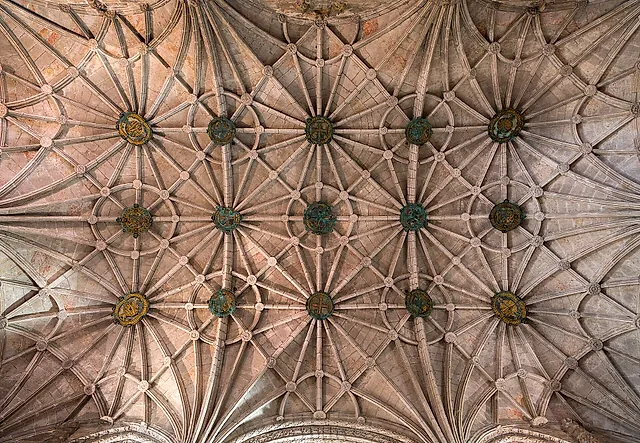
- Diogo de Boitaca, probably of French origin, directed the works from 1502 to 1516. He had worked at the Mosteiro de Jesus in Setúbal. He set the main structure and the grandeur of the church, with its ribbed vaults, and much of the cloister. The sources spell and describe him differently: Baedeker calls him “Boutaca” and Murray “João Potassi, an Italian”. We use the form of the monument.
- João de Castilho appears in 1516 and directs alone from 1517. He came from Cantabria and also worked at the Convento de Cristo at Tomar, at Batalha and at Braga Cathedral. He brought in Renaissance elements gradually. His dates of birth and death differ from guide to guide, so we give none.
- Diogo de Torralva resumed the project in 1540 and was master of works at Belém until 1551, in a more Italianate style.
- Jerónimo de Ruão took the chancel after the death of John III in 1557, when Queen Catherine ordered a new, innovative design that broke with the Manueline style of the church. He stayed in charge until his death in 1601, and after a little more than a hundred years from the start the monastery was largely complete.
The sources do not agree on who did what in several places. The monument gives the plan of the cloister to Boitaca and its upper floor to Castilho and Torralva, while Baedeker (1913, p. 506) calls the cloister Castilho’s masterpiece. For the south portal the monument names Castilho, while Baedeker (1913, p. 505) gives its sculptures to “Master Nicholas, the Frenchman”, and the monument gives Nicolau Chanterene the west portal. We credit Castilho with the design of the south portal only. The monument’s own pages are not consistent about the share of Torralva in the chancel and the choir, so we give only the chancel of Ruão. We also give no date for the choir stalls: the monument says they are by Diogo de Sarça, and Baedeker dates them to 1560.
The earthquake of 1755
Murray (1875, p. 27) says the building stands on piles of pine wood and “sustained scarcely any damage in the great earthquake”. A small part of a damaged vault fell about a year later, he adds. This is the only source we read on the subject, because the monument’s pages do not mention the earthquake.
1833: the monks leave
With the abolition of the religious orders in 1833, the monastery fell into neglect and lost part of its furnishings, says the monument. The Casa Pia, an institution that cared for orphans, beggars and the disadvantaged, occupied the premises from 1834 to 1940. Baedeker (1913, p. 505) counts about 500 pupils and tells of additions of 1859 to a design he finds very unsatisfactory, by the painters Rambois and Cinati, and Murray (1875, p. 34) says that in his day the school took boys only. The monument names the Italians Rambois and Cinatti as set designers of the Teatro São Carlos, who worked on the dormitory block. In 1878 the central block under construction collapsed and ten workers died.
Neo-Manueline and the tombs
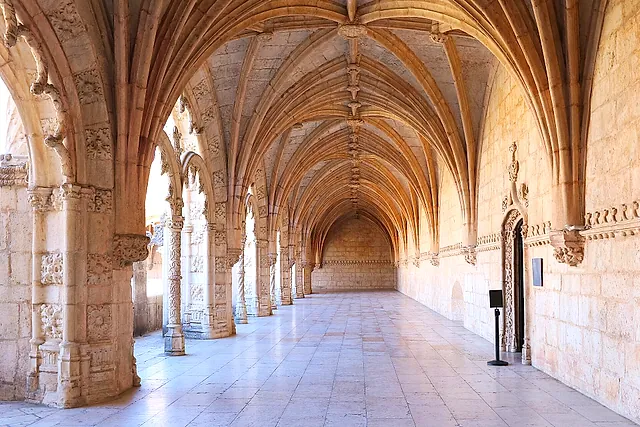
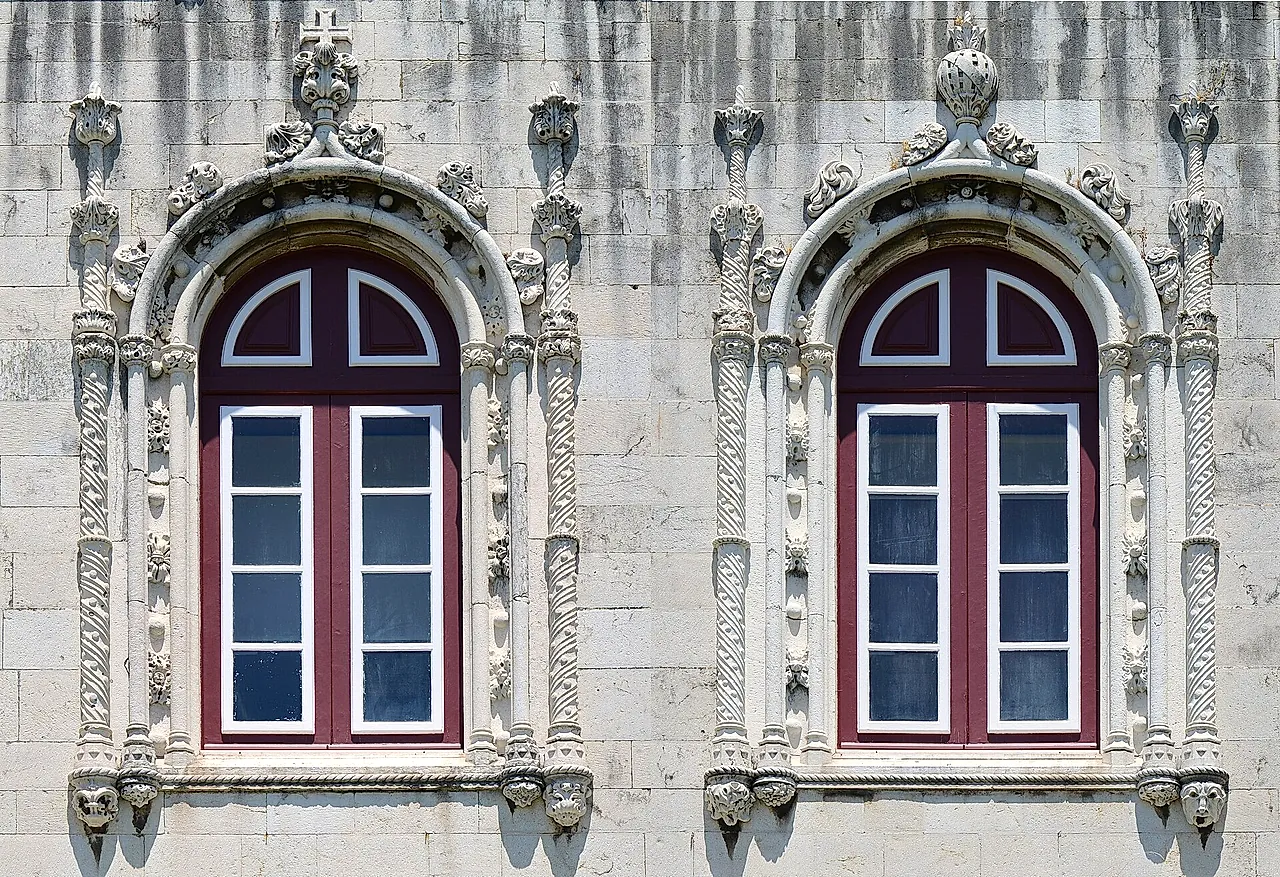
The 19th-century works draw on the Neo-Manueline, a Romantic revival that adds nautical motifs. The monument names the arcades of paired windows in the first floor of the dormitory, a rebuilt chapter house attributed to Raimundo Valadas and the restoration of the upper floor of the cloister in 1886. It says that most of the marine decoration seen today, ropes, fish, anchors and ships, is in these restored parts. The arches of the tombs of Camões and Vasco da Gama, by António Augusto da Costa Motta, were carved for the tercentenary of Camões, celebrated in 1880, when the remains of the two were brought into the church. Baedeker (1913, p. 506) confirms 1880 and places both coffins in the right arm of the transept. Today the tombs stand in the sub-choir at the entrance, according to the monument. English Wikipedia questions whether the remains are what they are said to be, which we could not check in a primary source.
The Fernando Pessoa tomb does not belong to this period: his remains came to the cloister in 1985, on the 50th anniversary of his death.
From the 20th century to the Treaty of Lisbon
In the early decades of the 20th century the organs of the upper choir were dismantled and the stained glass of the south front, by João Abel Manta, was installed, according to the monument. The Portuguese World Exhibition of 1940 brought more restorations, and the Casa Pia left the building.
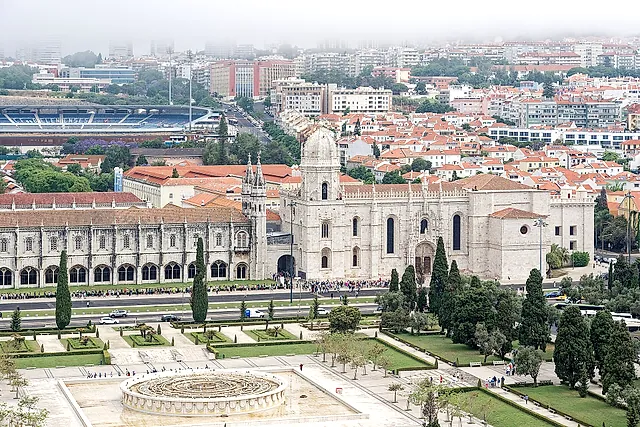
The state-owned building now houses three institutions. According to the monument, the Maritime Museum (Museu de Marinha) is in the west part, the Museu Nacional de Arqueologia is in the central block of the old dormitories, and the cloister and the church are managed by the state museums body, with the church open for worship. Baedeker (1913, p. 507) records that in his day the west end of the south wing held the Museu Ethnologico Portuguez, there since 1903. Today the Archaeology museum is closed for refurbishment and the Maritime Museum is open.
The monastery became a National Monument in 1907 and, with the Belém Tower, a UNESCO World Heritage site in 1983, under criteria iii and vi. UNESCO links the complex directly to the Age of the Discoveries. The monument’s website also speaks of the status of National Pantheon since 2016. According to English, Italian and Japanese Wikipedia, the Treaty of Lisbon was signed at the monastery on 13 December 2007. We could not read an EU source on that, so we cite the encyclopedia.
For what you can see today, read what to see. For the rules on the day, see the visit tips, and for how the time-slot ticket works, the tickets guide.